
Some time ago I got a job interview for a great position in a company I always wanted to work. The first question in the technical interview was: what is the difference between RSRP and SINR? Spoiler alert; this is not a happy ending story. In the mix of anxiety, lack of sleep and my ego trying to show off, I gave the worst, and over complicated answer ever (yes, it happened sometimes). Anyway, this post is about that question, and how a proper answer should look like. So let’s get started.
First things first; let´s answer the question
RSRP, SINR, RSRQ and RSSI are indicators of the signal strength and quality of the LTE channel. The 3GPP defined how the UE should calculate RSSI, RSRP and RSRQ. But SINR is vendor specific. In order to measure RSRP, SINR and RSRQ the UE has to achieve some degree of coherence demodulation and processing. This means that the UE can only get these measurements after it has achieve synchronization with the cell and got the relevant physical layer parameters like slot and frame timing. On the other hand, RSSI which is a carrier specific signal strength measurement does not require the UE to achieve synchronization.
RSRP – Reference Signal Received Power
The RSRP is a cell specific measurement of the signal strength. It is defined for a specific cell as the linear average over the power contributions (in W) of the resource elements that carry the Reference Signal blocks within the considered frequency bandwidth. This measurement is used normally to rank different LTE cells in cell selection, cell reselection or handover. One last thing, according to TS 36.211 the RSRP should be calculated through RS from port 0. The RS from antenna port 1 can be used if the UE can determine that is transmitted.
Unit: dBm.
Range: -44 dBm to -140 dBm.
Step: 1dB
RSSI – Carrier Received Signal Strength Indicator
The RSSI is the power measured by the UE in the entire frequency band of a given cell. This include power received from the serving and interfering cells (neighbor cells), and the thermal noise. As I mentioned before, the UE does not need to achieve synchronization to get this measurement.
RSRQ – Reference Signal Received Quality
RSRQ is not a direct measurement but a calculation done with the previous two quantities. The 3GPP defined RSRQ as:
RSRQ = N . RSRP / LTE carrier RSSI (in Watts) or RSRQ = 10 log (N) + RSRP – LTE carrier RSSI (in dB)
Where N is the number of resource block over the measured bandwidth (see table below)

As it happened with RSRP this quantity is also used by the UE to rank cells for cell reselection and handover. The 3GPP established that this quantity is used for RRC_IDLE intra-frequency, RRC_IDLE inter-frequency, RRC_CONNECTED intra-frequency and RRC_CONNECTED inter-frequency. I have not mentioned before, but RSRQ (and RSRP) is not reported with negative values. Instead the UE uses a table to map the different values of RSRQ; being 0 for RSRQ values below -19.5 dBm, 34 corresponding to RSRQ values equals or higher of -3 dBm and a linear distribution of values between these two limits with steps of 0.5 dBm.
SINR – Signal to Interference plus Noise Ratio
SINR is the ratio between the received power and the interference (plus noise). The 3GPP does not specifies how this quantity should be calculated (means that each phone manufacturer defines it), but the UE uses it for QCI estimation.
Some calculations
Using a Rohde Schwarz qualipoc I got the following measurements of the physical layer:

We can try to calculate the RSRQ value and see if it match with the one reported by the UE. First we have that the channel bandwidth is 20 MHz, which means that there are 100 RB availables (according to the table above). So let’s try the equation in dB:
RSRQ = 10 log (N) + RSRP – LTE carrier RSSI so RSRQ = 10 log (100) + (-87.0 dBm) – (-59.0 dBm)
RSRQ = 20 -87.0 dBm + 59.0 dBm = -8 dB
As I mentioned before, the UE will report a normalized value of RSRQ according to the rules I listed above (in “the internet” there are a lot of tables that shows this mapping). In this particular case, the corresponding RSRQ reporting value of a RSRQ of -8 dB is 23.
Good, Bad and Fair Measured values of RSRP, RSRQ, SINR
Now that is clear how these measurements are performed, how can we tell if a certain RSRP or RSRQ is good or not?
First, good, bad or fair are subjective qualities, please take this into consideration. Second, measurements like RSRP does not help to determine why we have low throughput, for instance. These measurements alone might not explain certain KPIs, but can give you an idea of the radio environment:
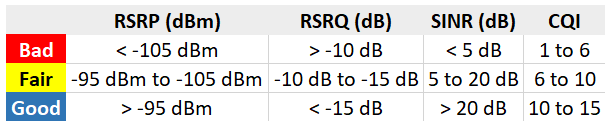
CQI Channel Quality Indicator) is a direct indicator of the modulation scheme that the UE might use for transmission. A CQI below 6 allows to use just QPSK, from 6 to 10 it maps to 16QAM and above 10 it allows 64QAM and 256QAM.
Conclusions
Before I started to write this post I check on a multitude of pages and blogs, and I cannot tell you the amount of sites where you will find incorrect data. In one even the RSRQ formula was wrong (very, very wrong). Anyway I hope that you find this information I have shared useful. In the reference section below there are some pages and documents where you can find even more information about the subject.
Cheers!
Diego Goncalves Kovadloff
References
3GPP TS 36.214 – 3rd Generation Partnership Project; Technical Specification Group Radio Access Network; Evolved Universal Terrestrial Radio Access (E-UTRA); Physical layer; Measurements (Release 15)
 Radio Frequency Optimization Notes: Essential Tips for Network Performance