
Finally 3G is saying goodbye. With it goes the last circuit switched voice service on a wireless system. 3G was a transition technology towards a full packet system. I still remember a vendor presenting 3G with the strong belief that with that technology, people will migrate from voice calls to video calls. Besides false Nostradamus predictions, the truth is that with technology advance, new technology is developed. We couldn’t advance to 5G without 4G and 3G.
In this post I’ll present the most common issues I have find in 3G networks and what to do to solve them. It might look a little messy as no particular order has been set to it.
3G Soft handover Overhead definition – Soft and Softer Handover
3G UMTS networks were unique in the way that mobility occurs. The handover, that is the passing a call from an NodeB to another, is continuous. When the UE arrives to the handover area (soft handover), it will establish a new radio link with the target cell way before dropping the serving one. In fact the UE can have multiple radio links at the same time (normally 3).
The UE is in Soft handover when is in connection with at least two NodeB. Softer handover is called in the particular scenario where the connections are with different cells of the same NodeB. The UE can be in soft and softer handover at the same time, but is not all the time in soft or softer handover. There is an area of coverage of the serving NB that no other NB will have connections to the UE attached there. Soft handover overhead is the ratio of radio links with just the server node and the radio links with multiple nodes while on the server area.
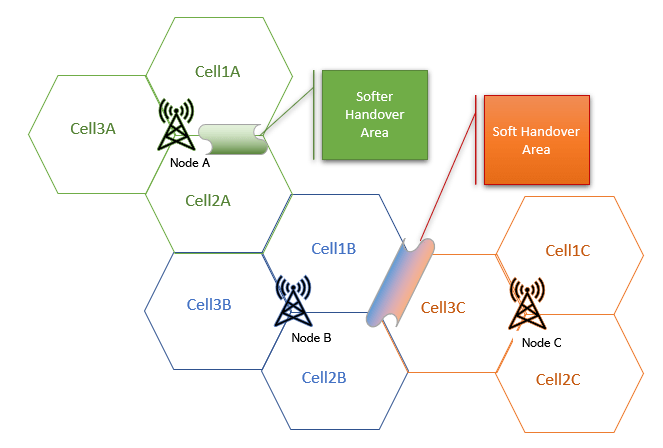
The soft handover overhead (SHO) is an important measurement as it shows the overlap that exist in the network. Operators wants this measurement to be low (below 35%) as a big SHO also indicates that there are resources in the network wasted. How we can keep SHO on target? there two ways: 1) doing RF shaping to control coverage of the sites that impacts the most or 2) play around with the active set parameters.
Active set and Events 1a and 1b
The active set is made of the cells where the UE has a radio link attached too (a.k.a. in soft handover or softer handover). It has a limited number of cells allowed to be part of it (in Ericsson the RNC parameter from handover MO maxActiveSet)
Once the UE enters the CELL_DCH state then Soft Handover and Softer Handover Evaluation is enabled. Then Soft and Softer Handover are controlled through the events 1a, 1b, 1c, and 1d:
1a: A new candidate for the active set crosses the threshold of the reporting range
1b: A cell in the active set leaves the reporting range threshold (its Ec/No or RSCP)
1c: A cell that is not currently in the active set becomes stronger than a cell in the active set
1d: A cell becomes better than the best cell in the active set
Controlling the thresholds of the active set
The active set is controlled by four parameters. The entrance to the active set is regulated by the parameter reportingRange1a and the timer timeToTrigger1a. On the other hand to exit the active set reportingRange1b and timeToTrigger1b controls this procedure:
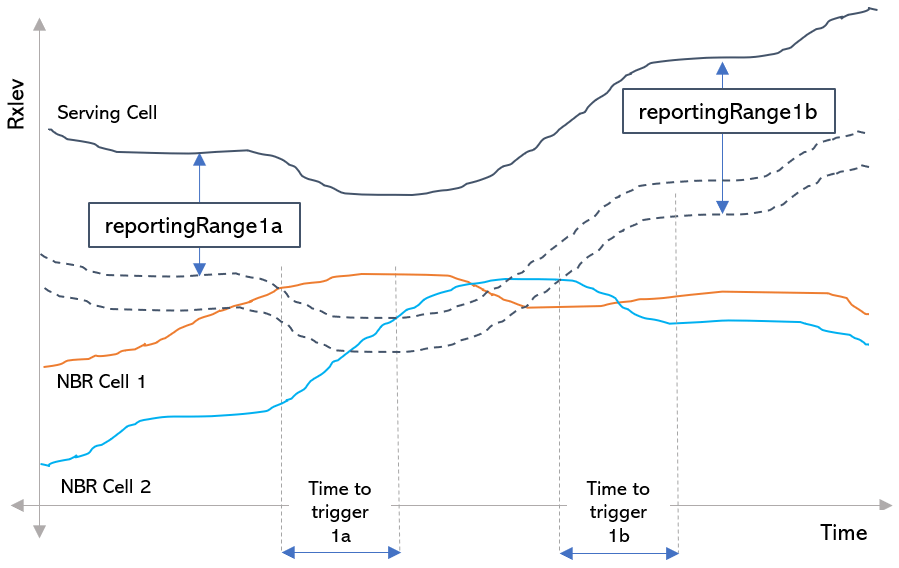
Both reportingRange1a and reportingRange1b are offsets in dB from the serving cell measurement quantity (the report quantity is CPICH Ec/No and RSCP). Time to trigger are timers during which the condition that triggers the event has to be fulfilled. I have not mentioned this but there is also hysteresis attached to reportingRange1a and 1b to avoid ping pong.
When a measured quantity from a cell that is not included in the Active Set, is reportingRange1a + hysteresis1a/2 better, and the measured value remains in reportingRange1a + hysteresis1a/2 at least a time equal to timeToTrigger1a seconds, then the event 1a occurs. The UE sends a MEASUREMENT REPORT message for event 1a to the SRNC.
Reducing the Soft Handover Overhead
Soft handover overhead is an indirect measurement of how well the planning was made. This measurement is normally high in networks with poor planning, where overlap is common and there are the so called killer sites (also known as over shooters, but I prefered the terminator style definition).
But there is a way to reduce the soft handover overhead even in this scenario; and this is by shortening the reportingRange1A and reportingRange1B. When you reduce the value of these two reporting range you might want to keep the difference between both. For example let say that your reportingRange1A is 6 and reportingRange1B is 9, then you can reduce both by 2 dB (reportingRange1A = 4 and reportingRange1B = 7) maintaining the 3 dB window between them. In fact I have I used this configuration on an Urban scenario with good results (reportingRange1A = 4 and reportingRange1B = 7). Still there is a tradeoff. If you reduce the reportingRange you might end up increasing drop call. My final recommendation is that if you are going that way, do it in small steps keeping an eye on CS and PS drop call rate.
Cheers!
Diego Goncalves Kovadloff
 Radio Frequency Optimization Notes: Essential Tips for Network Performance