

On one of my first posts I have described the Idle Mode process and how the UE, after it decodes PSS and SSS, acquires information of the Master Information Block. This information although esencial is very limited; it consisted in the System frame number, PHICH (Physical channel HybridARQ Indicator Channel) configuration (Ng value and wherever normal or extended mode is used) and system bandwidth measured in resource blocks (6, 15, 25, 50, 75 or 100). Hence more information is needed, and here appears the System Information Blocks (or SIB, for short).
System Information Block
System Information Blocks (SIB) provides common information to all UE in the network. SIB are transmitted in the downlink through the DL-SCH (downlink shared channel). As SIB contains information about the networks and the features it supports, the list of SIB has been growing over time as more features have been lunch (SIB 24 for instance, which provides reselection towards NR related information). In order to identify the scheduling of System Information messages, the UE looks for the SI-RNTI (System Information – Radio Network Temporary Identifier) on the PDCCH.
System Information Block Type 1
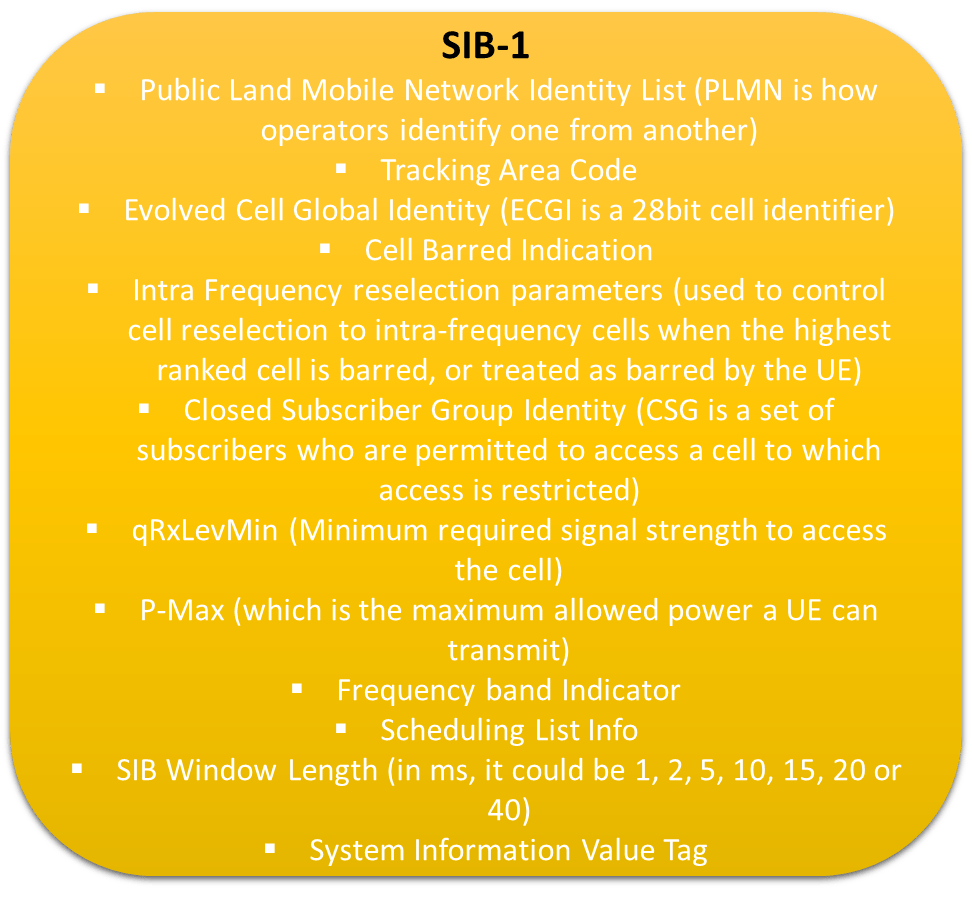
SIB-1 Contains essential information that the UE uses to evaluate if it is allowed to access a cell or not. Also defines the scheduling of other system information blocks.
System Information Block Type 2
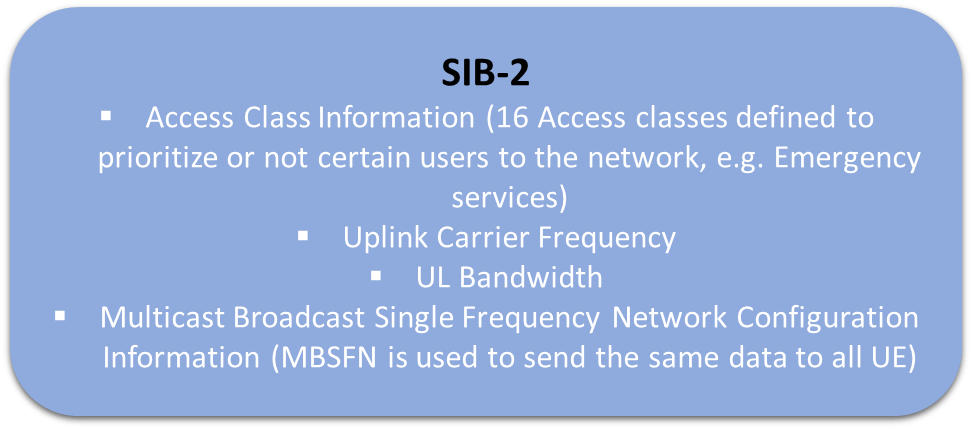
SIB-2 Contains common and shared channel information.
System Information Block Type 3
SIB-3 Contains contains cell re-selection information, mainly related to the serving cell. This information is common for intra-frequency, inter-frequency and/or inter-RAT cell reselection. Also intra-frequency cell reselection information other than that which is neighbor cell related.

System Information Block Type 4
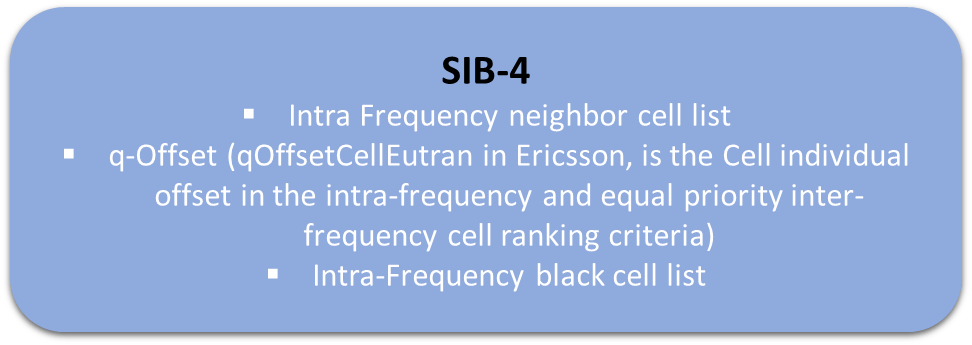
SIB-4 Contains information about the serving frequency and intra-frequency neighbouring cells relevant for cell re-selection (including cell re-selection parameters common for a frequency as well as cell specific re-selection parameters). Black listed cells are included in SIB-4.
System Information Block Type 5
SIB-5 contains information about other E‑UTRA frequencies and inter-frequency neighbouring cells relevant for cell re-selection (including cell re-selection parameters common for a frequency as well as cell specific re-selection parameters).

System Information Block Type 6
SIB-6 is the equivalent of SIB-5 or SIB-4 but for UTRA frequencies and UTRA neighbouring cells.

System Information Block Type 7
SIB-7 contains all the relevant information required for reselection inter-RAT GERAN cells. Including cell reselection parameter for each frequency.

System Information Block Type 8
SIB-8 contains information about CDMA2000 frequencies and CDMA2000 neighbouring cells relevant for cell re-selection (including cell re-selection parameters common for a frequency as well as cell specific re-selection parameters).
System Information Block Type 9
SIB-9 contains a home eNB name (HNB name).
System Information Block Type 10 and 11
SIB-10 contains an ETWS primary notification and SIB-11 contains an ETWS secondary notification. ETWS is the Earthquake and Tsunami Warning System.
System Information Block Type 12
SIB-12 contains CMAS warning notification. The Federal Commercial Mobile Alert System (CMAS) works in this fashion: Authorized national, state or local government officials send alerts regarding public safety emergencies, such as a tornado or a terrorist threat to CMAS. CMAS authenticates the alert, verifies that the sender is authorized and sends it to participating wireless carriers.
Cheers!
Diego Goncalves Kovadloff
References:
All the SIB for LTE and IOT are listes in https://portal.3gpp.org/
 Radio Frequency Optimization Notes: Essential Tips for Network Performance