

Introduction
When migrating from 3G to 4G, or even from 2G to 3G there was no option than a fully and complete roll out of the new technology in the CORE and RAN. Of course there was certain coexistence, for example 4G did support fallback of voice services to any other legacy technology while IMS where deployed to support VoLTE.
On the contrary, for 5G the 3GPP has defined several scenarios to deploy the new generation technology, depending on how much the service provider is willing to invest.
Two Paradigms, several Options
Briefly there are 2 different paradigms for deploying 5G:
Paradigm 1 | Non Stand Alone – Using the same EPC (4G core), adding 5G NR as a secondary radio access type
Paradigm 2 | Stand Alone – Both the legacy LTE network and the 5G NR are connected to the new 5G core (5GC)
Paradigm 1 is also called “option 3 variants”. Here 5G is deployed as a secondary rat in dual connectivity. This variants required almost no change in the core side (EPC) while deploying 5G NR technology.
Option 3: Differences, advantages and disadvantages
When 3GPP R12 was released the concept of dual connectivity emerged. With dual connectivity an UE can communicate with 2 different eNB at the same time so it can use the resources of both eNB to increase its throughput. The eNBs in DC communicate and synchronize each other through the X2 interface, although they both remain independent (e.g. they manage their own scheduler).
5G was NSA was designed to be essentially as a an enhancement of DC for the existing LTE eNB. The first phase of DC in 5G deployment is having an anchor LTE eNB with the same LTE core (EPC). The existings X2 and S1 interfaces needs to be upgraded to support the new connections to the gNB. This deployment scenario is called Option 3, and has 3 different sub options.
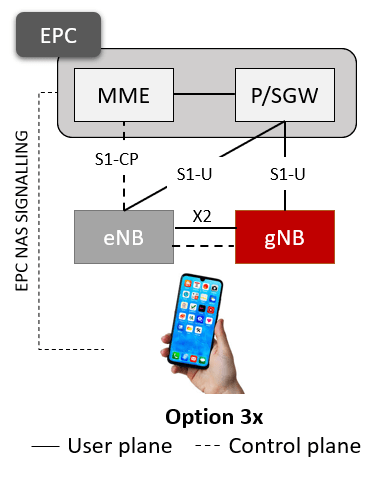
Option 3: In this option there is no S1-U connection between gNB and the P/SGW. This means that the anchor eNB is the endpoint of all the payload of the gNB. This option requires an upgrade on the eNB capacity and its backhaul in order to support the traffic generated from gNB.

Option 3a: Here a S1-U interface between gNB and the P/SGW exists. There are two different flows: the user plane from the gNB goes through the S1-U interface and the signalling is carried by the X2 interface. A bearer split is done at the EPC.

Option 3x: Option 3x is the most used. This option is similar to Option 3a, but the bearer split is done at the gNB on the PDCP layer which reduces significantly the load at the EPC. This scenario also provide a way to support mobility between gNB with anchor eNB and eNB alone.
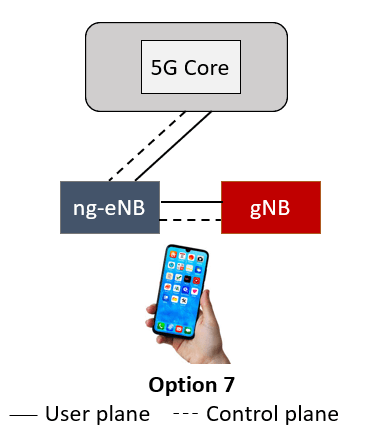
Option 7 – Halfway to a complete Stand Alone deployment
Moving forward to Option 3, the next deployment phase consider both a 5G Core (5GC) and a next generation radio access network (NG-RAN). There are 2 new interfaces in this phase: the backhaul will have a Ng interface, while the connection between gNBs will be carried in the Xg interface. This scenario is still not considered a full NSA 5G as is still maintaining the 4G eNB (now called ng-eNB) as anchor. A 4G ng-eNB anchor is utilized understanding that the 5G coverage at this stage is not equal to the underlying 4G. Similar to Option 3, Option 7 has 3 different sub-options.
Option 7: In this sub-option the 5G gNB is connected through a Xg interface to the anchor ng-eNB 4G. There is no direct connection from the gNB to the 5GC. The bearer split in this scenario is performed at the 4G ng-eNB.
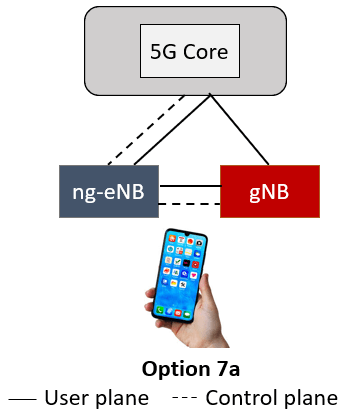
Option 7a: In this sub-option the 5G gNB is now connected to the 5GC. This link is only for user plane. In this option the bearer split is performed at the 5GC.
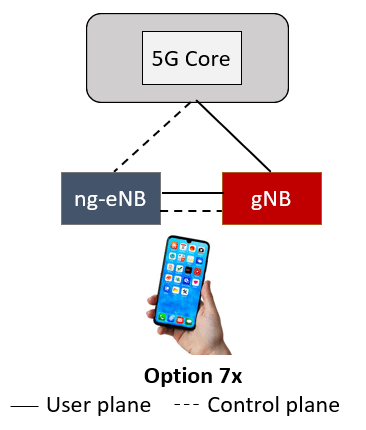
Option 7x: Identically as in Option 3x, Option 7x is the most popular. In this option the bearer split is performed at the gNB.
Option 7 series is intended to be used when there is still no complete 5G coverage, so continuous coverage is available only at the 4G layer. The 5GC that is part of this scenario allows the service provider to support more 5G services and features.
Stand alone Options
There are mainly two options for 5G SA deployment:
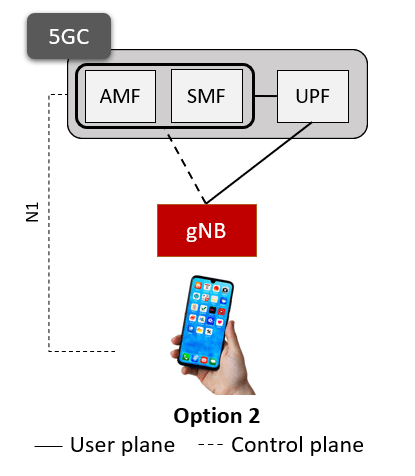
Option 2: This option contains both a 5G Core and a 5G NR gNB.
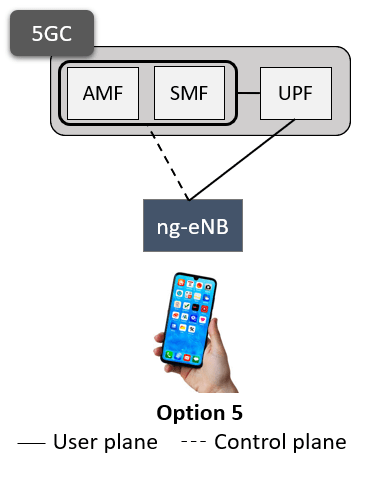
Option 5: Similar to option 2, here is a 5G core, but the RAN part is performed by a 4G ng-eNB, which limits the new 5G functionalities and services.
And were are the other options?
Yes! there are more options. Although most of this scenarios are just theoretical with no practical use. On the NSA side we have Option 4 (with the sub- options 4 and 4a) that is a similar architecture as Option 2 but with a 4G ng-eNB as anchor. On the SA side there is Option 1 (pure LTE core and RAN) and Option 6 (an gNB connected to a 4G EPC).
References:
3GPP, “3rd Generation Partnership Project; Technical Specification Group System Architecture; System architecture for the 5G System (5GS) (Release 15),” 23.501, v15.8.0, December 2019.
3GPP, “3rd Generation Partnership Project; Technical Specification Group System Architecture; Procedures for the 5G System (5GS) (Release 15),” 23.502, v15.8.0, December 2019.
3GPP, “3rd Generation Partnership Project; Technical Specification Group Radio Access Network; NG-RAN; Architecture description,” 38.401, v15.7.0, September 2019.
Diego Goncalves Kovadloff
 Radio Frequency Optimization Notes: Essential Tips for Network Performance