

Networks are getting more and more complex. With every new technology adopted there is another layer to add the existing architecture. This post is about exploring different alternatives to organize our networks. As always I will put some examples, but take in mind that every network has its own requirements. Still the concepts you will see here may apply for every network.
Carrier Strategies
There are basically 3 carrier strategies:
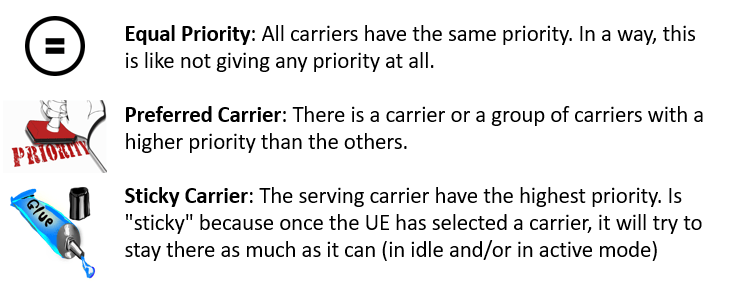
Although these strategies are commonly used use between carriers of the same technology they can also be used between different technologies. For example, is very likely that if your network has rolled out 5G, it will have a higher priority than the other technologies to push traffic to it (similar to preferred carrier).
Is also worth mention that you can mix these strategies between idle and connected mode. This mixing strategies works well in equal priority and preferred carrier, but I do not recommend it if you are using sticky carrier.
Idle, connected and detach
There are 3 possible different states for an UE in LTE: Idle, connected and detach. The first two are managed by the ECM (EPS Connection Management function) and the detach by the EMM (EPS Mobility Management function). The relation between these 3 states are listed in the following diagram:
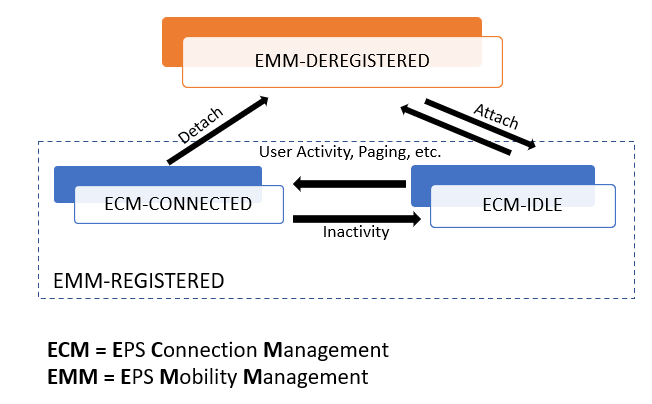
I’ll not go deeper in these, as is not the intention of this post (there is another post on Idle mode in this web). But the idea here is that the carrier strategy should be set on Idle and Connected Mode.
Idle Mode
The following is an example on how to configure the three strategies on the same technology. It can be used in any technology, but in this case I’m using LTE parameters:
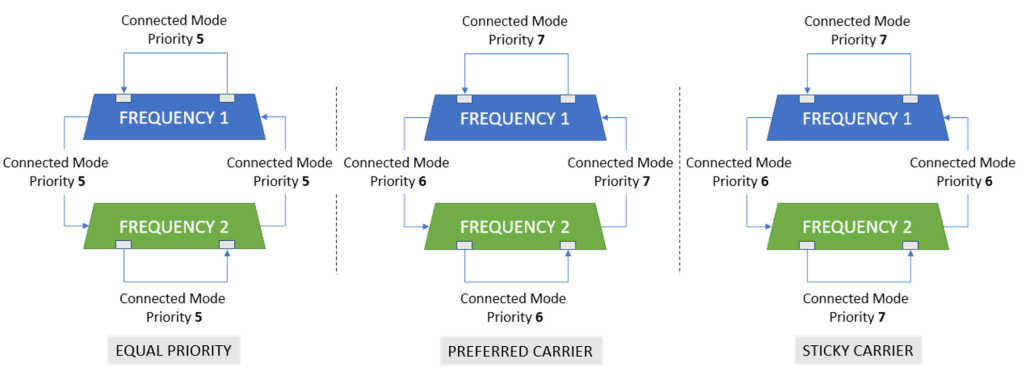
The way the UE reselect between carriers is done in LTE through just one parameter which is the cell reselection priority parameter (Ericsson: cellReselectionPriority, Nokia: cellReSelPrio). In UMTS Ericsson uses the absPrioCellRes.cellReselectionPriority parameter to do the trick.
Equal Priority assigns the same priority to the frequency relation. Preferred Carrier assigned a different priority (higher or lower) to different frequency carriers on the frequency relation. Sticky Carrier on the other hand uses the same priority to reselect from a eNB with the same frequency, and another priority (lower) to reselect to another frequency. By doing this the UE is “trapped” in one frequency and the only way to get out of it is by losing accepted levels of coverage.
Connected Mode
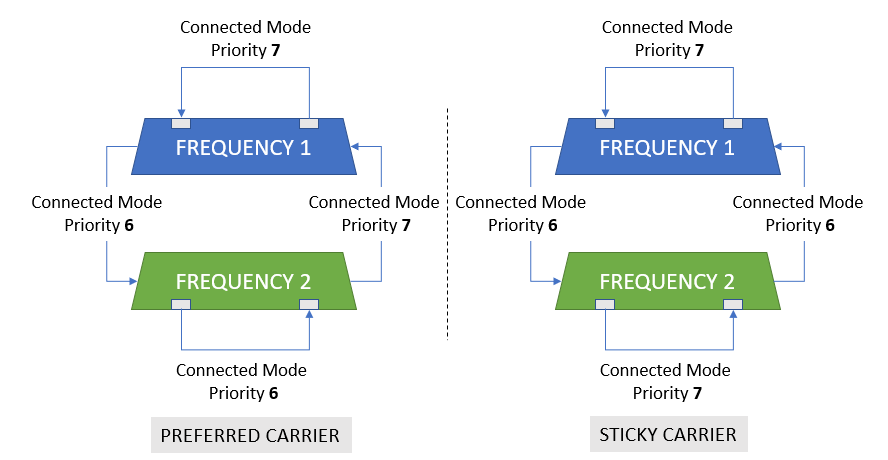
Similar to idle mode there are some parameters to use to control the chosen strategy in connected mode. For Ericsson we there is a parameter called connectedmodemobilityprio to set the priority between carriers (absolute and relative). I do not recall a similar parameter in Nokia, but there is a way to tell the UE not to measure a particular frequency. In Ericsson is done by setting the connectedmodemobilityprio parameter to -1.
Equal Priority, Preferred Carrier or Sticky Carrier; which one is better?
The short answer is that depends on the load balancing functions that the system has. If load balance is done in a very basic way (e.g. PRB load) Preferred carrier can work better in cases where you have uneven bandwidth carriers. But if your balancing functions have some sort of “intelligence”, then sticky carrier should be tried. In this way once the network has taken the decision on which carrier the UE should be, it will remain there no mater if is in connected or idle mode.
There is another consideration to make and is regarding the inter frequency handover. Is not desirable to have load balance inter-frequency HO on the cell edge as it can lead to mobility failure and session drops. So we often look to have inter-frequency load balance in good radio conditions. Then 2 different thresholds should be used for inter-frequency handover: one for Load balance and the other for last mobility resource before drop.
Inter-Frequency Handover by A3 or A5?
We can triggered inter-frequency handover with both A3 or A5 event. But for inter-frequency load balance handover we normally select A5. Why is that? A3 is triggered by the difference of RSRP or RSRQ (or both depending on your settings) between current cell/frequency and target cell/frequency, which is similar to say that the A3 event is a relative threshold. On the other hand A5 is about certain absolute boundaries in origin and target cell, that if crossed it will triggered the handover. As A5 is an absolute threshold, is more intuitive to use it for load balancing. We want the inter-frequency load balance handover to be triggered at good signal levels, which is easier to set with A5. For more insights about handover you can check my previous post Handover Concept in LTE.
Conclusion
In my humble opinion, manual layer management has the days counted. The complexity of load management and mobility SON has to be handled in an automatic way. There are enough tools and data and even more reasons to do it in that way. In the meantime we have to do it in the old fashion of testing and evaluating. I hope this post has been useful in your layer managing network settings.
Cheers!
Diego Goncalves Kovadloff
 Radio Frequency Optimization Notes: Essential Tips for Network Performance