

Although similar to DL throughput, UL throughput has special considerations to take when analyzing performance issues on a network. Ericsson defined throughput (UL or DL) is “the speed at which packets are being transferred by the time the first packet has been scheduled in the air interface”. This definition is important as we need to understand when we consider the flow of packets in UL has started and when it ends.

If you have read my previous block “Improving low DL throughput in LTE“, you will notice the extreme similarity of how throughput is measured in UL and DL. The concept is just the same. It all starts with the first data block scheduled in the UL. Notice that before this first data block, there is a random access procedure that takes place (scheduling request, access grant) that is not part of the throughput calculation. The data blocks are not a continuous flow, which means that there are transmission gaps and also error blocks (data blocks that failed at reception). The last block empty the buffer and is used as notification of the end of the transmission. Normally UL throughput is the sum of all the data arrived, divided by the time it took between the first data block was scheduled and the arrival of the empty buffer. The last TTI is discarded from the throughput calculation. Also Ericsson does not take into consideration the first four receptions blocks.
Taken all this into consideration we can model a UL throughput formulae like the following:
UL Throughput = (UL Data Transmitted – Last TTI data) / Time Elapsed
Where to focus the research of an UL throughput issue?
UL throughput can be affected by various factors. The most common are listed below:
- BLER (Block Error Rate)
- High RSSI (up link interference)
- Scheduling Algorithm
- Resources demand (very high and low demand)
- Low power headroom
- Other (VSWR, backhaul capacity, etc.)
I did not mentioned poor efficiency in UL as I consider that the efficiency is the result of other factors. In my personal experience, is very difficult to link throughput with efficiency (both UL and DL).
Interference
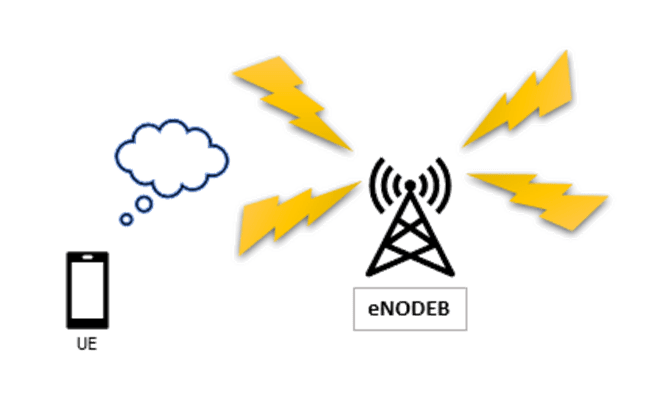
Starting in the radio environment category, High UL RSSI can be listed on top of the issues that can affect UL throughput. To identify this problem there are counters that shows poor UL SINR. You can use counters over PUCCH or over PUSCH to verify that UL RSSI is not an issue. There are even some vendors that have the possibility to measure UL RSSI per PRB. If you work with Ericsson equipment you might want to check pmRadioRecInterferencePwrPucch and pmRadioRecInterferencePwr counters.
Small Power Headroom
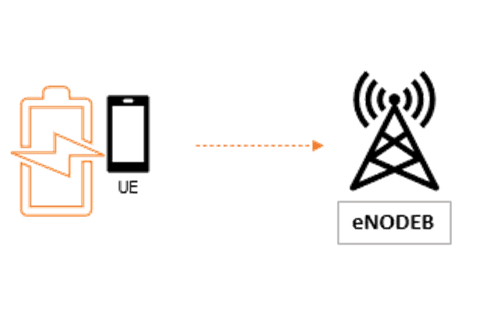
Power headroom does not refer to the amount of battery in the phone, but has something to do with the transmitted power. The power setting started with pZeroNominalPusch and pZeroNominalPucch, but how these parameters affects UL throughput? The thing is that you need enough power headroom to use high order modulations such as 64-QAM or 256-QAM. If the power objective defined by pZeroNominalPusch is too high, chances are that there will be no spare power in the UE to use for high order modulations. Support for 64-QAM in PUSCH by category 5 UE is defined by 3GPP since release 8.
BLER

BLER (block Error Rate) is an indication of poor UL coverage. Ericsson has a counter (pmRadioTbsPwrRestricted) that measured when the UE is power restricted even thou is transmitting to its maximum power. This is a good indicator of poor uplink coverage.
PRB Utilization
Another thing to consider is the utilization of the Physical Resource Blocks (PRBs) on the Physical Uplink Shared Channel. To have good throughput the PRB utilization shall not exceed 80% (this is true for both UL and DL). Reducing the PRB utilization is a challenge. Usually the efforts are directed to offloading traffic to other carriers or neighbors. Another thing that can be considered is to reduce the inactivity timer, or to utilize any feature that allows you to release inactive UEs.
Scheduler Fairness
Similar to downlink throughput the scheduler plays a big part in the UL throughput as well. The fairness the scheduler is treating the UE, less throughput is achieved on a cell level. In Ericsson LTE RAN we have the Max C/I algorithm that allows to schedule more those UE with better C/I conditions (most unfair), and is the one where highest throughput can be achieve.
Other things to consider
The implementation Carrier Aggregation in UL is a feature specified in the 3GPP 36101 that allows two inter-band non-contiguous or intra-band contiguous components carrier in UL, which provides higher throughput.
Other feature to try is the use of prescheduling methods. This allows to give PUSCH grants to an UE in advance reducing latency.
Cheers!
Diego Goncalves Kovadloff
References:
(yes! There are references because I’m not chat GTP)
Trinh Van Chien and Emil Björnson (2017). “Massive MIMO Communications” (PDF) part of “5G Mobile Communications”, Ed. Wei Xiang, Kan Zheng, Xuemin (Sherman) Shen
Specification #36.300

 Radio Frequency Optimization Notes: Essential Tips for Network Performance