
Circuit Switch fall back (or CSFB for short) provides voice service in LTE when IMS is not available or not all the LTE users have been migrated to VoLTE services or not all the universe of UE in the network support VoLTE.
From the network perspective it does not require a lot of settings. When the UE needs a voice service it will transmit an Extended Service Request Message to the serving MME. After received it the MME will instruct the eNB where the UE is connected, to release the UE from LTE network and redirect it to a predefined WCDMA/GSM frequency.
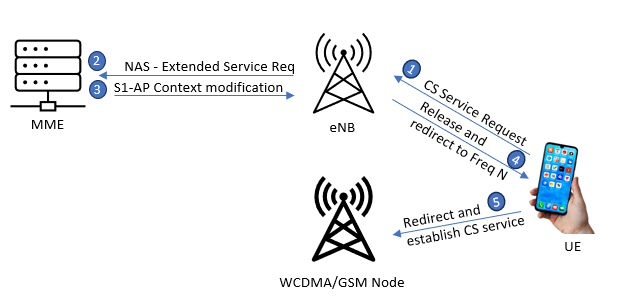
The way the UE selects the frequency and technology to acquire CS service is driven by first, the UE capabilities, and second by the csFallBackPrio parameter (in Ericsson RAN, freqLayListCsfbHighWcdma in Nokia RAN) . But it will be inaccurate to say that the UE is who choose the technology and frequency to fallback. The one that takes the decision is the eNB, and for that it takes into consideration both parameters mentioned before and also the UE capabilities and frequency/technology priority. Note that there could be several carriers sharing the same priority. Then the eNB will select them in a round robin fashion.
Once a new frequency/technology is selected, the eNB initiates a blind RRC (Radio Resource Control) connection release procedure with redirection that will send the release message to the UE. Then the UE release the existing RAT and initiates an access in a new RAT. The UE will send a CM service request to the RNC or the BSC so it can start the circuit switch session.
Once the CS session is completed and the UE returns to RRC_IDLE state the UE will initiate a reselection to LTE procedure.
Network requirements for CSFB
As it was mentioned above there are not much parameters settings. In Ericsson RAN a couple of features needs to be active. A feature called Coverage-Triggered WCDMA Session Continuity and the feature CSFBtoGsmWcdma are needed to be active so CSFB to UMTS and or GSM is operative. As mentioned before the UE must support both LTE and UMTS (or GSM). There should be frequency relation to UMTS (and/or GSM) and finally there should be UMTS or GSM coverage in the place where CSFB is required to be triggered.
Issues commonly found
Incorrect network settings: when CSFB is not occurring, the network settings should be reviewed. The network setting that must be check are the following:
- Active Features: In Ericsson there are 2 network features that should be active: CSFBtoGsmWcdma and Wcdmasessioncontinuity. Both features should have valid licenses and the feature state activated.
- Frequency Relations: There should be defined the target frequency in the MO:UtranFreqRelations. In this MO, the parameter csFallbackPrio established the absolute priority for CSFB.
Configuration mismatch: there could be a configuration mismatch that could prevent a CSFB from occurring. For example: The relationship between LAC (in 3G) and TAC (in LTE) has to be consistent. Two things can go wrong here:
- TAC does not match with the underlying LAC. Is might happened after a rehoming or after a new site is integrated with incorrect RF data.
- LAC/TAC is correct, but the relationship is not listed in MME. This issue is less common as it can generate failures in a large area. But is still something to review.
CSFB call setup time
An important measurement that is required to keep track is the call setup time, as it has high impact on how the user perceives the quality of service of the call. How small the call setup time should be? Usually this measurement comes from benchmarking reports, so is good or bad by comparing it to the competitors. Depending on the vendor there are some features that helps to reduce the call setup time. In Ericsson you can prioritize CS over PS when CSFB occurs, or make the eNB to submit the system Information (like UMTS cell access parameters) with the redirect message to speed up the access to the RAT where the UE will place the call.
Here is a capture of a CSFB log in Actix One:
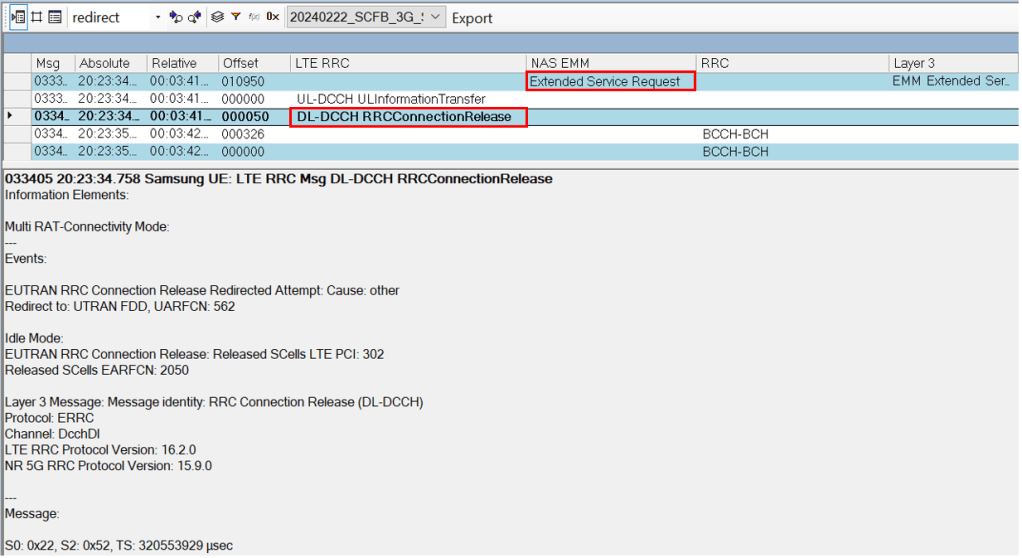
You can see that the information submitted from the eNB at redirect is quite small. Only the UARFCN is given. If more information is given to the UE, time can be saved at the selection and at accessing the UMTS cell.
In conclusion: CSFB failures have few investigation lines: both network consistency and configuration mismatch should be check. Luckily there are not a big number of parameters and checking’s to ensure the correct operation of this feature.
Cheers!
Diego Goncalves Kovadloff
References:
3GPP, “Digital cellular telecommunications system (Phase 2+); Universal Mobile Telecommunications System (UMTS); LTE; Circuit Switched (CS) fallback in Evolved Packet System (EPS); Stage 2” 3GPP TS 13.272, v10.4.0, June 2011.
 Radio Frequency Optimization Notes: Essential Tips for Network Performance