
There are 3 important steps for the UE at initial access: first it has to acquire synchronization with the gNB; second, it has to grab the cell identification and lastly it has to read the system information (SI) of the cell that provides NR coverage. In this post we will get into the details of the physical layer procedures that take part into the UE-gNB synchronization and we will also have a glance at all the other procedures of Initial access on 5G
Synchronization procedure and relevant signals
Initial network access (e.g. power up), cell selection, cell reselection, CSI reporting of L1 RSRP and measurements of neighboring cells can triggered the synchronization procedure. This procedure is supported by the following channels and signals:
Synchronization Signals: They provide OFDM symbol synchronization. The synchronization signals are two: the primary synchronization signal (PSS) and the secondary synchronization signal (SSS). These signals provide the physical cell ID which is the way the UE finds the data and control channels of the serving cell.
Physical Broadcast Channel: The physical broadcast channel (PBCH) provides slot and radio frame synchronization. It also carries the master information block (MIB) and it provides the identification of the transmitted beam direction.
Physical Downlink Control Channel: The physical downlink control channel (PDCCH) along with the physical downlink shared channel (PDSCH) provide the system Information (SI) in the system information blocks (SIB). In order to the UE perform a random access, the reception of the SIB-1 (also called RMSI or Remaining Minimum System Information) is mandatory.
The synchronization signals and the PBCH are transmitted in a block called SS/PBCH block. The SS/PBCH block is transmitted at fixed locations in a half-frame. You may remember that in LTE the synchronization signals are transmitted every 5 ms, while in 5G-NR these blocks of SS and PBCH are transmitted by default at 20 ms
The Synchronization Signals / PBCH block
In LTE the UE rely on quick periodic frequency scanning of reference signals (you can find more details abut this on my earlier post eNB Identification) in order to perform the cell search. The need of a reduction of the “always-on” signals in NR brought the solution of the SS/PBCH block implementation. The SS/PBCH block spans 4 OFDM symbols in time domain and 20 RBs in the frequency domain.

By means of a technique called Beam-Sweeping the gNB will transmit one or more SS/PBCH blocks on a fixed downlink beam, before moving to another beam. To keep track of each beam, the gNB will transmit all its multiple sync signals containing a block index (SSB index) for identification purposes. The gNB will use the same antenna port during the entire SS/PBCH block transmission.
On the UE part, by receiving the SS/PBCH block it will be able to acquire time and frequency synchronization, get the physical cell identity (or PCI which stretches from 0 to 1007), get the SS/PBCH block index and the system frame number (SFN which goes from 0 to 1023). There is a slight change if the gNB is SA or NSA; on SA the UE will also received the remaining minimum system information (SIB-1) from the gNB; on a NSA that information will be provided by the master eNB. SIB-1 in NR carries similar information than SIB-1 + SIB-2 in LTE. As mentioned before, the SIB-1 provides the minimum information the UE requires to access the system.
Once the synchronization procedure is finished the UE will report back to the gNB the best SS/PBCH block index. This can be done on a random access or on the CSI reporting procedure, depending on which was the trigger of the sync procedure.
Physical Cell ID
On LTE there are just 504 different cell ID that can be referred to with the PSS and the SSS. On NR that number goes up to 1008. But the differences are more than just the number.
The PSS (primary synchronization signal) is a pseudo-random sequence (m-sequence) that can take values 0, 1 or 2. After receiving the PSS the UE will tune to the frequency identified by the synchronization raster an will correlate the incoming signal with the 3 possible PSS sequences. By doing that the UE will identify the cell identity within the group and acquire OFDM symbol time synchronization
The SSS (secondary synchronization signal) is also a pseudo-random sequence called gold-code. This sequence depends on the cell identity group, which goes from 0 up to 335 and the cell identity within the group (which is known by getting the PSS). In a similar manner than with the PSS, the UE will compare the incoming signal with the 336 sequence possibilities to identify the cell identity group.
The UE will then calculate the physical cell identity with the following formula:
Nidcell = 3*Nid(1) + Nid(2)
Where Nid(2) = is carried by the PSS {0,1,2} and the Nid(1) is carried by the SSS {0, 1,…,335}. NidCell is how the 3GPP specifications have denoted the cell ID. The cell ID plays an important role at scrambling of PBCH DMRS and the PBCH itself.
Beam-Sweeping
The gNB has a number of fixed beams that point to different directions. These beams are implemented by means of a fixed number of phase ramps. The gNB will sweep through each beam at regular intervals. Then the UE will get the transmission of the “best beam”. This is the technique used by 5G for synchronization: the gNB will transmit the PSS and SSS on beam-sweeping so the UE will get the best beam and it will report it back its identity (beam identity) to the gNB.
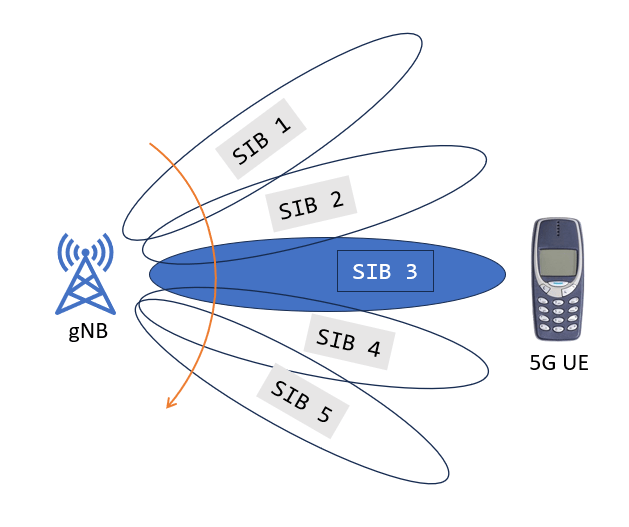
There is a maximum number of beam directions (or maximum number of SS/PBCH Block [SSB] indices) is given by the frequency range (e.g. FR1, FR2). In any case the SS/PBCH Block is transmitted within half frame, which is 5 ms
Conclusion: The synchronization process In a nutshell
Step 1 – Triggers: The synchronization process is triggered by another process. It can be Cell selection or cell reselection, measurements of neighboring cells or CSI reporting of L1 RSRP.
Step 2 – SS/PBCH block and Beam-Sweeping: The gNB will transmit the SS/PBCH block using Beam-Sweeping. The UE will be listening to the block that contains the PSS (Primary Synchronization Signal), the SSS (Secondary Synchronization Signal) and the PBCH (Physical Broadcast Channel)
Step 3 – The results: Symbol and time synchronization will be obtained by the UE after syncing into the synchronization signals and PBCH. After reading the PSS and the SSS the UE is capable of calculating the physical cell id (0 to 1007). By reading the “best SS/PBCH block beam” the UE will get the SSB index and the system frame number (SFN [0 to 1023]).
Step 4 – The UE reports back: (great title for the next Star Wars movie) The UE will report to the gNB the SS/PBCH block index (SSB index) in any of the following processes: random access, CSI reporting or measuring reporting.
Cheers!
Diego Goncalves Kovadloff
References:
3GPP, “3rd Generation Partnership Project; Technical Specification Group Radio Access Network; NR; physical channels and
modulation (Release 15),” 3GPP TS 38.211, v15.8.0, January 2020.
Montojo, J., Gaal, P., Zisimopoulos, H., & Chen, W. (2021). Fundamentals of 5G communications: Connectivity for enhanced mobile broadband and beyond. McGraw-Hill Education.
 Radio Frequency Optimization Notes: Essential Tips for Network Performance