

So, what is this Idle Mode anyway? Is defined Idle mode when the UE has no RRC connection attached to it. In this state the UE can perform a number of activities such as PLMN selection, cell selection, cell reselection, Tracking Area (TA) Update and Paging monitoring. In this post I´ll briefly described these procedures, but also my objective is to explain the parameters that are in control of them. So let’s start!
UE Initial Procedure

You may have noticed in the flowchart above that after the initial attachment the UE jumps to RRC connected state and it will remains like that for the time the RRC inactivity timer defines (if there is no data to be send or receive). The RRC inactivity timer is normally set to 20 seconds, but in loaded cells when the resources are scare it might be reduced up to 10 seconds. Vendors implement this parameter in different ways, for Huawei there is only one parameter (UeInactiveTimer) while Nokia uses a timer and a multiplier (LNCELinactivityTimerMult) to set this time.
PLMN Selection
The UE will look into the USIM (Universal Subscriber Identity Module) for information about which PLMN it has to get service from. This can be the Home PLMN or the Equivalent Home PLMN (EHPLMN). Although there is only one home PLMN, there could be many networks that provides services similar to the Home PLMN in roaming. The selection of the PLMN can be done manually or automatically. After the PLMN is selected the UE has to successfully been able to register to the EPC, else it has to start the process all over again.
What normally happened in the PLMN selection is that the UE has a record of a previous PLMN from which it has got service before. That is the PLMN that the UE will try to get service (register) first. If it cannot register to the previous registered PLMN or any EHPLMN the UE has to try each combination of PLMN with radio access technology stored in the “User Controlled PLMN Selector with Access Technology” data file in the USIM in the priority given. If the UE still fails to register it will attempt to register in any PLMN with RAT that provides a RSRP (Reference Signal Received Power) higher than -100 dBm. If still there is no suitable PLMN to register, the UE will try to select any RAT starting with the highest RSRP to the lowest. But if this fails too, the UE enters the Limited service state.
The USIM stores a lot of information useful to the UE when it has to select a PLMN to get service from. It also tell the UE how often it has to search its home PLMN when it is registered in a EHPLMN. For more information on USIM, please check the reference section at the end of this post.
Cell Selection
The UE will start the cell selection procedure after the PLMN selection or in case it has made a transition to Idle from RRC connected state. If the UE comes from a transition from RRC connected state it will first try to select the last cell the UE was camped on, else it will attempt to select a suitable cell on a frequency this last cell was allocated with the information stored in the RRC Connection Release message. If there is no stored information available, the UE scans all RF channels in the E-UTRAN bands according to its capabilities.
Either way the UE has to synchronize to a cell. By reading the SSS and the PSS the UE achieves time and frequency synchronization (frame, sub-frame, slot and symbol synchronization in the time domain; and it identifies the center of the channel bandwidth in the frequency domain) and calculates the Physical Layer Cell Identity or PCI (you can read more about this in my previous blog “eNB Identification – PCI Rules“.
After the UE is synchronized it has to look after the BCH transport channel to get the Master Information Block (MIB) and to the PSDCH to get information from the system information blocks (SIB).

From SIB1 the UE gets the information referred to cell selection and camping, and on SIB2 other basic radio parameters. SIB1 and SIB2 are mandatory and each vendor states the way we can control the periodicity and repetition. In Nokia the parameters sib2SchedulingsiMessagePeriodicity and sib2SchedulingsiMessageRepetition took care of the periodicity and repetition and on Huawei is the parameter sibXperiod which is measured in radio frames. The periodicity is normally set to 160 ms.
Cell Selection Criteria
Now that the UE has received all the necessary information from the system it has to select a cell to camp on it. The selection of the cell is done by measuring the Reference Signal (RS). From the RS it gets two very important measurements: the RSRP that is RS receiving Power (dBm) and the RSRQ that is the RS receiving quality and is calculated by taken into the consideration the RSRP (again) and the RSSI. Here is how the RSRQ is calculated:
RSRQ = N * RSRP/RSSI
Where N is the number of Resource Block corresponding to the channel bandwidth, RSRP is the average received power of a single resource element (84 RE in a resource block) and RSSI is the power measured over the entire bandwidth of occupied resources blocks (RB).
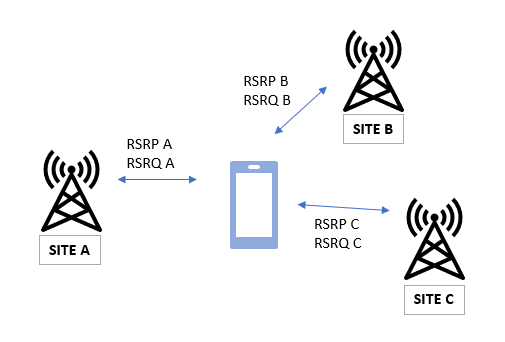
So, the UE measures RSRP and calculates RSRQ of all the neighboring cells, but it only evaluates a few. How it does this? by filtering through two thresholds defined by the parameters qQualMin and qRxLevMin (if you came from UMTS you might be very familiar with these two names). These parameters establishes the minimum RSRP and RSRQ the UE has to measure from a particular cell in order to the UE camps on it. Usual value for qRxLevMin is -124 dBm, and for qQualMin is -14 dB. Both qRxLevMin and qQualMin are sent to the UE through SIB1.
A cell is candidate for selection if the two conditions listed below are met:

So let me start to point out that there is an offset parameter that can be applied in both RSRP and RSRQ measurement. This offset can restrict or ease access to a particular cell. Very important: These offset are only valid for Cell Selection. The name of this parameter might change from vendor to vendor, but the idea is the same.
The last parameter pCompensation is part of the Srxlev calculation and is related to the maximum power that the UE can deliver (UE capability) and the maximum power the eNB can admit in up-link. The pCompensation is calculated in the following way:
pCompensation = max (Pmaximum power allowed – PUE Max Output Power, 0)
Where Pmaximum power allowed is sent through SIB1 and is normally set to 23 dBm
So here ends the part 1. On part two it comes cell reselection (the so called R criterion) and maybe an extra. If you want to expand your knowledge please check the references below.
Cheers!
Diego Goncalves Kovadloff
References:
USIM Detailed Information. Universal Mobile Telecommunications System (UMTS); LTE; Characteristics of the Universal Subscriber Identity Module (USIM) application (3GPP TS 31.102 version 12.5.0 Release 12)
LTE – The UMTS Long Term Evolution: From Theory to Practice Stefania Sesia, Issam Toufik and Matthew Baker. 2009 John Wiley & Sons.
Amazing Finding:
I find this page where you can calculate RSRP and RSRQ based on RSSI and channel bandwidth: https://www.rfwireless-world.com/calculators/LTE-RSRP-and-RSRQ-calculator.html
 Radio Frequency Optimization Notes: Essential Tips for Network Performance
Please correct me if i am wrong!! In the picture you have mentioned the PLMN selection before Cell search and MIB-SIB decoding. But as per my knowledge, PLMN details comes in SIB1. After which UE confirms about PLMN selection in RRC connection setup complete message.
LikeLike
Hi Gladson! The PLMN selection is a process that runs inside the USIM mostly. The UE will check which PLMN are suitable to get service from. Then comes the cell search where the UE will decode SIB1 to get the network details and see if there is a match (or not) with the suitable PLMNs he get in the first part of the process.
LikeLike