
Now that the UE has successfully selected a cell where to perform the initial attachment, the UE begins to decode the System Information Blocks (SIB). The information gathered from the SIB provides the UE with all the necessary input it needs to move and stay in the cell with the best condition possible. This process is called cell reselection.
LTE Layering
I work in a very unusual network. This network only has 3 carriers (frequencies) in a particular band. How the UE is choosing between the frequencies where to camp on? We can complicate things even further; chances are that the network you are working has several LTE frequencies, in many bands, plus an UMTS and/or a GSM legacy network. How the UE is able to manage the mobility between all? In LTE a layering concept is used to tell the UE where it has to camp (yes, LTE network has layers, like onions… and ogres) . If you want to know more about Network Layering, you can check my post Layer Management in this web.

Once minimum condition is met (defined by qRxLevMin), the absolute priority has the most importance in cell reselection. Absolute priority is delivered through the System Information Blocks or SIB:
- On SIB3 the priority of the serving cell is delivered.
- On SIB5 inter-frequency priority.
- On SIB6 UMTS priority.
- And on SIB7 is delivered the priority for GSM cells.
When priority is broadcast through SIB is referred as common priority as is intended for all the traffic, but there is another priority that is UE specific. The UE specific priority is sent through the RRC Connection Release message to a single UE. This priority is also referred as dedicated priority. Parameters for establishing absolute priority are cellReselPriority in Huawei and cellReSelPrio in Nokia.
In absolute priorities, 7 has the highest priority while 0 is the lowest. Different RAT must have a different priority number, that means they cannot have overlapping priorities. In an intra-cell reselection the priority is omitted by the UE, but for inter frequency or inter RAT reselection the UE will use priority in evaluation.
Intra-Frequency Reselection
On intra-frequency reselection there are two thresholds that establishes when does the UE have to start measure for other cells. These thresholds are defined by parameters S-intraSearch and S-intraSearchQ.
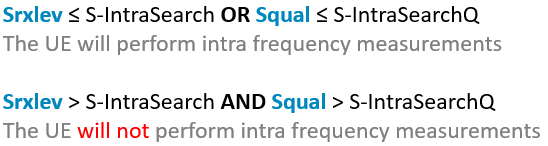
Srxlev and Squal parameters are the same used in cell selection (you can check this parameters in my previous blog Idle Mode Behavior in LTE – Part 1). S-intraSearchQ is not mandatory and some vendors uses switches to activate it or deactivate it. In Huawei you can do it through parameter SIntraSearchCfgInd, but in Nokia there is not that option available.

If you think that I have just copy the same image from the handover post, you are very right. There are some changes thou. Here the hysteresis is over the serving cell and the offset is over the neighbor (on handover is the way around). But the concept is exactly the same. Note that in order that this evaluation takes place the intra-frequency reselection criteria equation has to be true.
So in order to a UE to re-select to another cell the rxlev of the serving cell (plus a histeresys) has to be less than the rxlev of the neighbor (minus an offset) during a time defined in the Eutra reselection timer.
Another thing to mention is that both serving cell and neighbor measurements are in dBm (RSRP) and hysteresis and offset are in dB. Again the name of the parameters might be a little different from vendor to vendor: in Huawei the offset applied to the neighbor is CellQoffset while in Nokia is called intrFrNCListqOffsetCell; the reselection timer is called in Nokia interTResEut and in Huawei TreselEutran. A common set for this timer is 1 (second).
Inter-Frequency / Inter-RAT measurement criteria
Only inter-frequency / inter-RAT neighbors with higher priority are constantly measured by the UE. But with neighbors with lower priority the UE will measure them if:
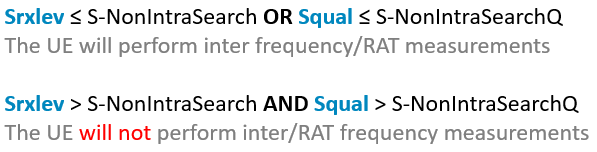
Srxlev and Squal parameters are the same used in cell selection (you can check this parameters in my previous blog Idle Mode Behavior in LTE – Part 1)
Higher priority reselection criteria
What happened if the target cell has a higher priority?
Srxlev has to be higher than thresX-High during the time specified in the Eutra reselection timer. Parameter thresX-High specifies the threshold used by the UE when reselecting towards a higher priority frequency X than the current serving frequency. In Nokia this parameter is utraFrqThrH and in Huawei ThreshXHigh and is normally set to 4 (8 dB).
Conclusions
Idle mode behavior is complex, but is one of the basics of any mobile telecommunications standard. If your coverage is well designed and your idle mode tune is very likely that you end with a high performance network. There are many more things to optimize, but Idle mode has to be the most important one.
Cheers!
Diego Goncalves Kovadloff
References:
USIM Detailed Information. Universal Mobile Telecommunications System (UMTS); LTE; Characteristics of the Universal Subscriber Identity Module (USIM) application (3GPP TS 31.102 version 12.5.0 Release 12)
LTE – The UMTS Long Term Evolution: From Theory to Practice Stefania Sesia, Issam Toufik and Matthew Baker. 2009 John Wiley & Sons.


Hi friend, thanks for your post. According to your example L2100-33 Prio 7, L2100-34 Prio 6 and L700 has Prio 5.
What does the UE do if it’s camping on L700 and is under good coverage of L2100-33 and L2100-34? But L2100-34 is around 3 dBs better than L2100-33. Would the reselection criteria be the priority or signal level/quality?
Even more, does the UE scan both L2100 carries simultaneously or scan highest priority carrier first?
LikeLike
Hey Manuel!
Yes the UE may camp on a lower priority E-UTRAN Frequency but it has to search for higher priority Frequencies. According to 3GPP TS 36.304 the UE can received absolute priorities of different E-UTRAN frequencies or inter-RAT frequencies by the system information, the RRC Connection Release message, or or by inheriting from another RAT at inter-RAT cell selection/reselection.
Once the UE has that information it will try to select a higher E-UTRAN Frequency. In order to select a higher priority frequency, the E-UTRAN Frequency must fulfill the selection criteria.
Note that there are several rules regarding how the UE store the E-UTRAN Frequency priorities. For example, if priorities are provided in dedicated signaling, the UE shall ignore all the priorities provided in system information. You can have the complete list of these rules on TS 36.304
Cheers!
Diego
LikeLike