
This is the second part of the LTE handover concept post. Here we will see some practical examples of handover optimization. Handover may take different forms, intra-cell, inter-cell, inter-frequency, inter-RAT and also can be triggered by coverage, frequency priority and load balancing algorithms. I’ll stick in this blog to inter-cell, intra frequency coverage based handover cases.
A3 Event
Imagine that for any reason an UE begins to move from a cell we will call “source cell” towards another cell we will call “target cell”. Let assume that coverage is overlapped at the cell border of both cells. It should looks something like this:

So we expect that the serving cell started to be worse in terms of RSRP/RSRQ while the neighbor cell is getting better. If we plot the RSRP / RSRQ against time for both cells the graph will look something like this:
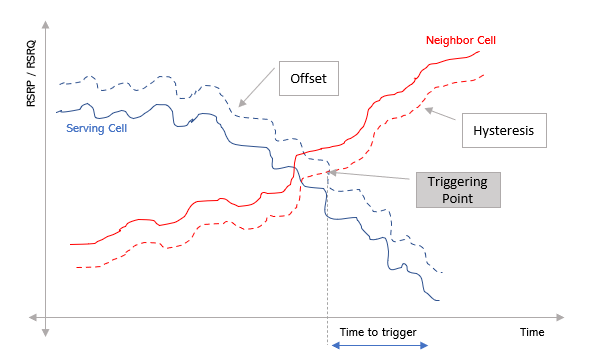
Note that there is an offset and a hysteresis line. Offset (on the serving cell) and hysteresis (on the target cell) are used to prevent handover back and forth or “ping pong handover” (that’s the the scientific term). So the condition that has to be met for triggering a HO due to an event 3A is the following:
RSRP Neighbor eNB + Offsetn– hysteresis > RSRP Serving eNB + A3 Offset
And this equation has to be true for the time defined in the Time to Trigger timer for HO to be ordered. Another thing to take in mind is that this event can be triggered by RSRP or RSRQ.
Remember I’m just listing conditions on intra-frequency handover, which is govern by the A3 event in this case (although it can be also triggered by A5 event).
A3 Time to Trigger: This timer speeds up or delays the handover command once the conditions are met. The default value is 320 ms but is commonly set higher to prevent too many handovers. This parameter is only available at lncell level.
A3 Offset: Increasing the offset can delay the handover. The default value is 3, but it might be set higher too if you want to delay handovers.
Offsetn: This is the so called cell individual offset. The default value is 0, but if the value is different you should take care of it sign. A positive value will speed up the Handover while a negative value will delay it.
A3 Hysteresis: A higher value speeds up the triggering point. This value is set at lncell level.
A3 Handover Trigger Quantity: Here you can choose between RSRP or RSRQ to be the quantities that are being taken into consideration for HO evaluation. The default is RSRP, but depending on your radio environment, RSRQ might be a better choice.
UE Signalling
Using a qualipoc I did a short walk through my neighborhood to catch a handover event, specifically I was interested in see all the signalling back and forth the UE:

The sequence starts with the measurement report sent by the UE to the eNB. The last measurement report “1” shows that the source cell (PCell) is worst in terms of RSRP/RSRQ that the best neighbour cell. The neighbor is better enough during at least the amount of time defined in the A3 time to trigger so Handover is requested.
What happened next is a negotiation between source eNB and target eNB (preparation phase). If succeed the handover will be requested from the source eNB to the UE, and this is what we see in the next RRC Reconfiguration message “2”. Note that in my previous blog “LTE Handover Concept” I show a different RRC Reconfiguration message which pases to the UE all the measurement information (what to measure and how often) . That RRC Reconfiguration message is called Measurement Configuration. This one instead is called Mobility Control Information, and is actually the Handover command. In the red square I highlighted some information I think is important; like for example the details of the source cell the UE has to handover too. Also how the UE will access is detailed here: the initial preamble power and if there are reserved preambles for contention free Random Access which in this case there are 8 (Number of random access preambles: 40 – sizeOfRA_PreamblesGroupA: n32)
In “3” we see the confirmation of a succeed handover through the rrcConnectionReconfigurationComplete message from the UE to the eNB. Later, the formerly called “target eNB” (now source eNB) will provide the UE with all the information it needs to continue the service on this cell (Master Information block and the RRC Reconfiguration message “measurement control”).
Handover Optimization
Handover success rate on a mature network should be greater than 99%. The following are the most common issues that could affect the handover performance:
- PCI confusion: This happened when two neighbor cells have the same PCI. In this scenario the UE will report a PCI with a RSRP/RSRQ that belongs to two different cells. You can have more information in this topic with my post “PCI confussion or PCI Collision?”
- Missing neighbor: In this case, there will be many measurement reports but no Mobility Control Information message (no handover command) even after A3 condition is met. This should be a problem not very often as most operators implements SON (self optimizing network) solutions that deal with the neighbor definitions.
- Wrong parameters: What is also called “fat finger error” is where in my experience you can find most of the major handover success rate affectations. The options are endless: from wrong offsets, to incorrect cell radius, or wrongly defined TAC (a ghost TAC that points nowhere) among others are things that you might find. All have in common that suddenly the number of handover attempts increase a lot (in a drive test it might look like a ping pong handover) while the success rate decreases. If you have a consistency check tool it may be time to run it, if not get one 🙂
- Poor radio environment: This includes areas of low RSRP and cross coverage or lack of dominance. Here the solution is to improve the radio conditions by tilts, change of azimuths or new sites. If that is not possible you should change handover parameters to reduce the number of handovers.
Conclusion
Handover performance is a very important KPI in an LTE Network. It might indirectly affect throughput and latency, which at the end affects the service perceived from the end user, which is in my opinion the most critical KPI. This blog is not covering all the handover process but I hope it gives you tools to work with. Finally I strongly recommend a book that is on my references that goes very deep and extensive on handover.
Cheers!
Diego Goncalves Kovadloff
References:
LTE – The UMTS Long Term Evolution: From Theory to Practice Stefania Sesia, Issam Toufik and Matthew Baker, 2009 John Wiley & Sons
 Radio Frequency Optimization Notes: Essential Tips for Network Performance
Excellent understanding on Handover Concept
LikeLike
Thank you for your feedback Jitendra!
LikeLike
Thanks for share: I´m confused, Is it correct, the condition to initiate the HO process?
“RSRP Serving eNB + Offset > RSRP Neighbor eNB – hysteresis”
or is “<"
LikeLike
You are completely right Eduardo. I have noticed too my big finger error and I have correct it. Thanks a lot for your comment!
LikeLike
Now I am confused, because the original formula to start the HO process, considering Offset= 0 is:
RSRP Neighbor eNB – hysteresis > RSRP Serving eNB + A3 Offset
that is the same as:
RSRP Serving eNB + A3 Offset < RSRP Neighbor eNB – hysteresis
in other words, for me the formula original is right.
Did I miss something?
LikeLike
Not sure about your question… both equations are correct. The most important thing that I tried to highlight is that A3 is a relative threshold and A5 is an absolute threshold. You can use either to trigger intra or inter HO depending on the scenario. For instance, for urgency HO in coverage edge A5 is preferred.
LikeLike
Hi Diogo, I forgot to mention why I did my comment. Sorry about that. Let´s start again:
In your very good post above, the condition to start a HO process based on A3 Event is:
A) RSRP Neighbor eNB + Offsetn– hysteresis > RSRP Serving eNB + A3 Offset
Considering Offsetn= 0, the formula becames:
B) RSRP Neighbor eNB – hysteresis > RSRP Serving eNB + A3 Offset
In February/2021 Eduardo posted the following comment:
Thanks for share: I´m confused, Is it correct, the condition to initiate the HO process?
C) “RSRP Serving eNB + Offset > RSRP Neighbor eNB – hysteresis”
or is “<“
And then you answered:
You are completely right Eduardo. I have noticed too my big finger error and I have correct it. Thanks a lot for your comment!
But in my mind, the formula depict in (C) from Eduardo is in wrong way, related to the original formula of your post (B).
Concluding: The formula A is right and the major signal does not must to be changed to minor signal.
Regards
Silvino
LikeLike
Thanks for the clarification Silvino and much appreciated your comments. Is true, somehow the formulae did generate some confusion but they are correct (for entering and leaving). Your appreciation is right, that’s why I have left the formula as it is. Thanks!! Diego
LikeLike
DiEgo, thanks and sorry about my “fat finger error” writing your name.
Regards
Silvino
LikeLiked by 1 person