
Have you ever heard about spectrum refarming? The wireless spectrum is one of the most (if not the most) expensive assets of the telecom service providers. In a given time when service providers bid for a portion of the wireless spectrum available to start operating, they have a clear idea what they are going to do with it. For example when Miniphone in Argentina acquire 12.4 MHz to deploy an AMPS network back in 1994, they already know that all that spectrum will be used for all the available AMPS channels that can fit into it.
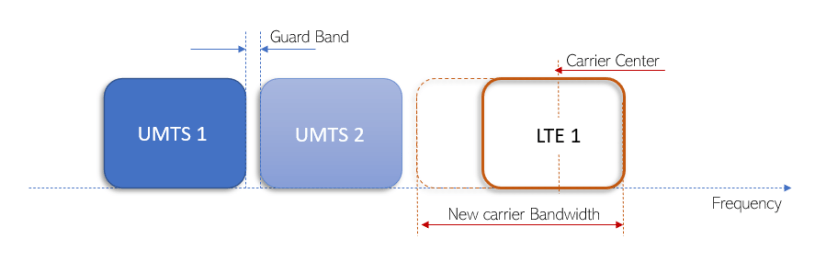
2G and 3G are already gone in USA and Europe, but there are several networks around the globe that are still using these technologies and at the same time they are jumping into 5G. This transition is only possible if several technologies share the same spectrum. The allocation of spectrum that was once used by one technology to allocate bandwidth for another technology is called spectrum refarming.
The idea is quite simple, but there are a number of things that are necessary to solve first.
1- Ensure that the technology that is shrinking can cope with the current traffic.
Let say you are taking one 3G carrier (5 MHz or 4.2 MHz) to assign it to LTE. The first step will be to verify that in LTE the B2 threshold (b2Threshold1Rsrp and b2Threshold2Rscp) and the qRxLevMin (and TheshXLow) are correctly set and most traffic is kept in LTE. Also in the 3G side review that both active and idle setting towards LTE are correctly set. Ericsson has a feature called LTE Cell Reselection for Advanced LTE networks which works very well to push idle traffic in 3G towards 4G.
2- Calculate the frequency allocation for all technologies
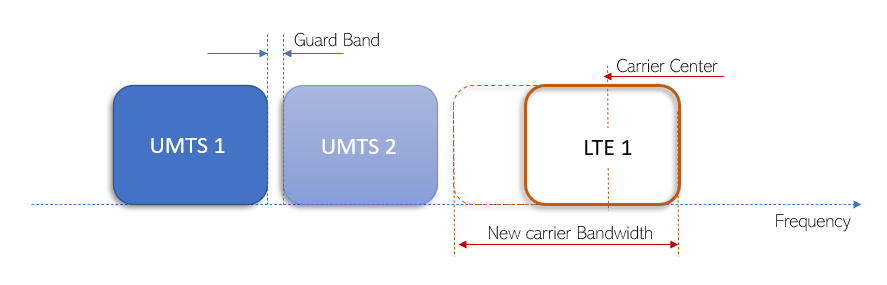
Following with the same example where 3G is giving spectrum for LTE there are 2 options: one is that LTE is having a new frequency of just 5 MHz or LTE is growing an existing frequency 5 MHz more. Both scenarios require to perform the carrier frequency allocation that can utilize most of the available spectrum.
There are many EARFCN, UARFCN and ARFCN calculators out there. I have used one from the blog RF Wireless World that I recommend and you can also check here in the following links:
3- Take into consideration actions to compensate coverage loss
The first refarming I did long time ago was reducing GSM channels so another UMTS carrier can fit in that spectrum. At that time BaseBand and RRU were not that common. Basically the first phase was to deploy extra HW on each site. Nowadays you can have in the same LTE radio any bandwidth (*) so if you go from a 5 MHz carrier to 10 MHz carrier, is very likely that you are going to be good with the existing HW. However Reference Signal power changes with the bandwidth. Take this calculation of RS power for example:
RS = Power(of a single port) – 10 log(12* Total RB) + 10 log (1 + Pb)
Where:
Power: is the available power (Ericsson maximumTransmissionPower from SectorCarrier MO)
RB: are the Resource Blocks which depends on the bandwidth (100 RB for 20 MHz, 75 for 15 MHz, 50 for 10 MHz, 25 for 5 MHz, 15 for 3 MHz and 7 for 1.4 MHz)
PB: Is a delta between the RS and other symbols.
With more bandwidth, there will be a reduction of RS power. As is a logarithmic function, it is not the same loss if you add 5 MHz to and existing carrier of 5 MHz or to an existing carrier of 15 MHz. In the first example you may lose around 3dB while in the last one roughly 1.25 dB.
At the end, coverage should be check pre and post refarming. It can be done with traditional methods like drive test, or with a drive less tool such as Amdocs Actix One or the most popular Viavi Nitrogeo.
4- Other things to consider
I have mention in the previous block that now is not necessary to change HW if you are increasing BW into LTE or 5G NR, but this is not completely true. HW has its limitations and it depends on models, vendors and many others. Is important to check that the HW utilized can cope with the new bandwidth.
Another thing to consider is the licenses on the eNB. Review with your vendor if additional capacity licenses has to be installed in case of a bandwidth increase.
Conclusions
Refarmings are inevitable as technology evolves and more BW is required for new technologies. Users that are adopting new technologies want to see an improvement in performance from the old one. This is why, even in cases where the old technology temporarily suffers some congestion, moving spectrum to new technologies are beneficial for telecom providers.
Cheers!
Diego Goncalves Kovadloff


Well done brother, great information
LikeLike